Showing posts with label reviews. Show all posts

Monday, May 30, 2011

Review: Akata Witch by Nnede Okorafor

Akata Witch

Nnede Okorafor

352 pages

Publication Date: April 14, 2011

Publisher: Viking Juvenile

Source: Library

Age group: MG (Middle Grade)

No matter which way you look at it, Sunny is an outsider. She lives in Nigeria with her family but spent almost the first decade of her life living in the United States. On top of that she’s an albino, used to the stares and taunts from people especially her classmates. But when strange things start happening: visions in a candle’s flames and the revelation that one of her classmates have magical abilities (and she does too), Sunny’s life drastically changes. She’s introduced to magic, people, and places that she didn’t even know existed. There’s a war coming between the forces of good and evil and it seems like Sunny will be in the middle of it.

There is so much to enjoy about Akata Witch. With many novels there’s an introduction into the character’s life before the action starts. Not with this book. Right from the very beginning readers are thrown into Sunny’s story as she sits alone in her room, watching a vision so intensely in the flame that her hair catches fire. Pretty much every chapter in this book is filled with action and readers are able to see Sunny’s growth as a girl who’s already sure of herself become a girl with that same self-confidence but who’s also willing to put herself in danger to help others.

With its setting in Nigeria the magic, myths, landscape, and culture that readers encounter in the book are different and refreshing from the magic that’s usually found in fantasy novels. Learning about the different ethnic groups and languages in Nigeria was slowly embedded in the story and it didn’t feel like an anthropology lesson.

My only gripe with the book is the disappointing ending. Sunny and her friends have to battle an evil wizard to stop an ancient monster from coming back into her world. It’s something they have to do by themselves. The battle happens but there’s almost no build-up of suspense and readers are left with this flat battle in the end. Even with the ending, I’m not going to let that stop me from reading everything else by Okorafor or the next book in this new series once it’s published. Recommended read for middle grade readers.

Tuesday, August 24, 2010

Two Mothers - One Daughter

Secret Daughter by Shilpi Somaya Gowda.
This is the story of two mothers and one daughter. It begins in a small village in India. The year is 1984. Kavita a young bride is in labor. In a country were the birth of boys are favored, Kavita can only watch as husband, Jasu takes away her daughter. No one speaks of the daughter that is taken to her death. Kavita will not lose another daughter this way. Somer is a doctor and happily married to Krishnan (Kris) also a doctor. The two live in San Francisco. Somer has everything she wants in life, expect a child. When we first meet Somer she's having another misscarriage. For much of the book the story alternates between the voices of these two women. I loved the beginning, it really pulled me in.

When Kavita has another daughter, she sneaks off to the capital of India with her sister. Kavita risks everything to take her daughter to an orphanage. Kris convinces Somer the best thing they can do is adopt a child from his home country of India. The two adopt Kavita's daughter. Asha is 1 yrs old when she makes her way to her new country.

Once I started reading Secret Daughter, I didn't want to stop. As Asha grows older, we see how both families lives differ. Kavita finally as a boy. Jasu moves the family to Bombay. Kavita misses the daughter she never knew. Kavita has the daughter she always wanted to and she's too scared to let Asha explore her Indian heritage for fear of losing her. Asha is in college when she first returns to her home country of India.

Its the strength of the beginning that makes this a successful debut. It middle felt a little rush as if the author wanted to quickly get to the part where the main characters lives might cross. IKavita and Somer were nice characters with clear voices. Though, I wish they were developed them a tad more. This was made more difficult when chapters were given to the husbands. It thinned out the possible character growth of Kavita and Somer.

I didn't like the ending as much as I would've liked, I thought Kavita got cheated. She gave Asha the only thing she could, life. If Kavita could have, she would've given more but it wasn't her choice. So I really felt for Kavita in the end. I found Somer's fear of losing her daughter a little frustrating at first. By the end I realized these were realistic fears of some adoptive parents.

Secret Daughter is a good novel and well worth reading. Part of the reason why I wanted more from this story is because I think the author has it to give. Gowda is a gifted storyteller.

At the naming ceremony for Kavita and Jasu's son - "Everyone cheers, repeating the name to one another. Somewhere in the noise of the crowd, Kavita hears a lone voice, an infant's piercing cry. She looks at her son, who is sleeping. Her eyes dart around the room, trying to find the origin of the cry, but she sees no other babies. Jasu places the baby in a cradle decorated with garlands of bright orange marigolds, white and red chrysanthemums, and begins to rock it from sided to side. The other women in the room slowly come forward and surround them. Kavita is engulfed by their signing voices but even this cannot drown out the high pitched cry she still hears. For a moment, she is struck with the disturbing thought that everything in her son's life might be bittersweet for her."

There's something great about catching an author at the beginning of their career. I will definitely be keeping my eye on Shilpi Somaya Gowda.

Monday, August 23, 2010

A Novel With Jamaican Patois

Blue Moutain Trouble by Martin Mordecai

This is the story of 11 yr old twins Pollyread and Jackson Gilmore. The Gilmore family lives in a village, located in Top Valley. The twins and the rest of the 6th graders are waiting on the result exam that will determine where they will go to school next year.

On there way to school Pollyread and Jackson spot a magical goat that appears out of nowhere.

The twins could only see a huge head, with a billowing beard and horns like they had never before seen, on a goat or any other creature. It was like a mask, of a size that would've had a body as big as a minibus carrying it. Unsupported, it floated next to a big round rock - just where they would walk. The twins stopped dead. There was no way around it. The goat's eyes pinned them, flashing dark fire. The eyes seemed sightless but seeing everything too, down into the very darkest corners of their terror.

Mordecai give us a wonderful look into the Pollyread and Jackson's world. The author was born and raised in Jamaica, and that shines through on every page, from the patois dialect to the stories rhythm. When I read a lyrical novel such as this, I am happily reminded that words can read like music. I absolutely loved it.

Right from the beginning, I knew this was a novel I wouldn't forget anytime soon.
"For Pollyread and Jackson, walking down to school around the same time each morning was the same and slightly different. The twins lived in Top Valley, a village high in the Blue Mountains. "On God shoulder," Mama said. Mornings sometimes, when cloud and mist were all around, there you'd be on God's shoulder and you couldn't see his face or his feet. They looked down the path they were walking, and where a moment ago there was Stedman's Corner and Marcus Garvey Primary, then Cross Point, then Cuthbert Bank and Content Gap, in steps that a drunk giant might take to the hazyblue sea far below - now all of a sudden there was only cloud thick as Mama's soup slicking the grass and stones with moisture and making the path where they walked all their life mysterious and new, and sometimes dangerous."

Blue Mountain Trouble is one of the best 2009 debut's that I missed. Its so well written and such a pleasure to read. One of the things I loved and appreciated - the author's voice is loud and clear throughout. I don't often talk about editors or publishers this is not one of those times.

Blue Mountain Trouble would make a wonderful boy/girl book club selection. ages 10up. It was shortlisted for the Canadian Library Assiocation's (CLA) 2010 Book of the Year Award for Children.

Monday, August 16, 2010

A Love of Chicle, A Trip to the Yucatan Jungles

Chavela and the Magic Bubble by Monica Brown illus. Magaly Morales

Chavela is very close to her grandmother, loves chewing gum (chicle) and making big bubbles. She can make bubbles in the shape of animals. One day Chavela chews a magic piece of chicle and flies to the Yucatan jungles.

She meets the chicleros who harvest the sweet fruit from sapodilla trees to make chewing gum. Chavela is welcomed by the children. Chavela goes on a wonderful adventure. There is a very nice unexpected surprise at the end.

Brown's text is beautiful as always. I am pretty sure Brown is blessed with an illustrator fairy. Once again, she is matched up with, an artist whose style is perfect for this story. Morales is not afraid of color (lucky us) The text curves, when word bubbles appear, making it a very visually fun book. You will be wowed. Its beautiful. A great read alound choice. Also a wonderful story for grandmother's to share with grandaughters. In the afterword, Brown includes some facts about chiclero farmers.

"On Saturdays, Chavela and her grandmother would split a piece of gum and go shopping on Market Street. Chavela's abuelita would tell her stories about the quiet town of Playa del Carmen, Mexico, where she grew up. One morning Abuelita was telling Chavela about the beautiful rainforest and the bird and the butterflies that lived there, when Chavela blew a big bubble shaped like a butterfly! "Bravo!" said Abuelita. "

Friday, August 13, 2010

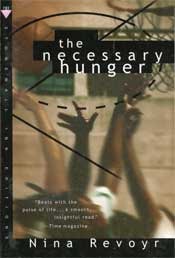
The Necessary Hunger

The Necessary Hunger by Nina Revoyr 1997
Simon & Schuster

Nancy Takhiro is a high school basketball star and she is in love with Raina Webber, her biggest competitor. Raina has a girlfriend and Nancy can't work up the courage to tell her how she feels. When Nancy's father falls in love with Raina's mother, the girls soon find themselves living together. They become good friends who are fiercely competitive with each other (they play on opposing teams). Together they will face the crazy world of college recruitment. Nancy isn't ready to leave the world of high school and L.A., Raina is ready to go.
The future is unforeseeable but their senior year is here and it's going to be one long journey.

"And there were certain topics we never touched upon-our missing parents, what my father might know about me, my utter lack of love life-because we couldn't have talked about anything real without talking about what existed, and didn't exist, between us. But the irony of our holiday crisis, the unforeseen result, was that our friendship, having survived it, was actually stronger. Because of the pain we'd experienced and the knowledge we'd gained, there was a fullness to our relationship that hadn't existed before. We appreciated it now, we meant more to each other." (pg.259) This quote is rather lengthy but it sums up the feelings of both girls for a large part of the book. The Necessary Hunger doesn't really seem to have a plot. It's mostly about Nancy trying to work up the courage to tell Raina how she feels and this takes an incredibly long time (368 pages). The book is a decent length, but I had a hard time concentrating in some places and it probably could have been pared down a little. I could only take so much of Nancy talking about her passionate feelings for Raina and then not acting on them. I also got tired of watching Nancy watch Raina and Toni (Raina's girlfriend) hang out and get in arguments. The end is extremely dissatisfying and yet, realistic of young, first love.

The best part of the novel is the snippets about the lives of Nancy's teammates. I LOVED all the basketball mentions in the novel. It's set in the 1980s before the WNBA was created, so the girls are wondering what's next for them after college. Some want to play pro overseas, others don't. Some of them make costly mistakes, some aren't good enough basketball players to get scholarships, others didn't apply themselves enough in school to get academic scholarships. Most of the girls are facing junior college. Nancy and Raina are one of the lucky ones from their neighborhood. At times, I wondered if people really treat high school basketball stars the way these girls get treated. Random people stop them on the street, especially young kids in order to praise them. We have a decent basketball team and the stars of the team are quite popular, but I doubt a junior high kid is going to stop the star girl or guy player. But that could just be me. Chicago is a big city and there's lots of star players so it's hard to know them all, but then again L.A. is a big city. Anyway, the author writes great descriptions of basketball games from the atmosphere of the crowd, the peeling paint of the gym, to the adrenaline of the players. It's an intense experience and while I don't play basketball anymore, it brought back some good (and painful) memories. The predictable ultimate basketball showdown occurs between Raina and Nancy, but you might be surprised by who wins.

Next to the intense basketball scenes and the glimpses into the lives of mostly African American and Latina basketball players, the prejudices of the Black community is discussed. There is no grand coming out in this novel, Nancy and her father have never discussed her sexual orientation. Raina and her mother have talked about it and her mother accepts her. It's as simple and yet complicated as that. Nancy and the reader can't help wondering if her father knows that she's a lesbian. I was surprised by how many girls on Nancy's team were lesbians but not all their teammates knew everyone's sexual orientation (which leads to some hilarious conversations). The reactions of all the parents isn't really discussed so I'm not sure what the ratio of accepting to disbelieving parents is, but there is a good mix. Nancy and Raina must also deal with people who have a problem with their multicultural family. Claudia's (Raina's mother) friends are mostly supportive of her marriage to a Japanese American man, but she has one friend who has a real problem with the situation. It's very interesting to read about and it shows that even if you're discriminated against, you too can still discriminate against others (without even thinking about the irony). Of course there is also racism from the Japanese American community toward Claudia and racism from the white community.

The Necessary Hunger is a descriptive book with graceful writing about a wide variety of topics. it takes you on a trip to a part of L.A. that you may not see on vacation. You meet girls who really have to struggle and they don't always triumph. You witness how odd it is that those who are discriminated against think it's OK to discriminate against others. I thought Nancy's mother had an intriguing story that I wanted to learn more about (she left Nancy and Nancy's father and basically renounced her Japanese heritage) but that would have made the book even longer. The story does drag a bit, but have some patience. Almost everything about race, class, sexual orientation and basketball is covered in this book. It's a great read and I highly recommend it.

Disclosure: From the library

PS The book was written when Michal Jordan was king (really he still is) but since it's set in the '80s, he's not really anything special just yet. There's one line that made me laugh and it went along the lines of "she wore baggy long shorts in the style of that young player Michael Jordan." (not an exact quote because I no longer have the book). I just love it, 'that young player MJ' :)

Tuesday, August 10, 2010

Uruguay : Historical Fiction

The Invisible Mountain by Carolina De Robertis
I heard nothing but great things about this 2009, fiction debut. This novel definitely lived up to the praise. Invisible Mountain is the story of three generations of Uruguayan women. Through Pajarita, Eva and Salome we also learn about the history and politics of Uruguay. The story begins with the birth, disappearance and reapperance of baby Pajarita.


As a married woman, Pajarita calls Montevido, the captial of Uruguay home. The miracle and magical element of Pajarita's beginnings set the tone for her daughter and granddaughter. These were going to be very special women.

One of the many things that stood out for me is the beautiful language. Its had a musical quality to it.

"Montevideo was unspun wool, full of rough billows, gray mazes, raw promise. Monte. Vide. Eu. I see a mountain, one of the first Europeans to sight this land said. Pajarita had never seen a mountain, but even she could tell there were none here. This city had no slopes. No, that was not true: its ground lay flat, but buildings pushed up everywhere, gathering their height into the sky. If only she could be a bird in more than name she'd soar above the city and then what would she see?"

Pajarita, Eva and Salome are wonderful characters. They are equal amounts strength and softness. Its was a pleasure to lose myself in their stories. Especially, Salome's who becomes active in Uruguay's 1960's revolution. At one point I found myself crying so hard I was choking. Though, it was an everything is going to be alright cry. The politics of the country and Salome's story go hand in hand.

The paperback edition of The Invisible Mountain was released today.

Monday, August 9, 2010

A Ninth Ward Novel

Ninth Ward by Jewell Parker Rhodes

Earlier in the year I was so excited when I found out Jewell Parker Rhodes had a middle grade novel coming out. If the name sounds familiar its because Rhodes is an award winning author of adult fiction.

12 yr old Lanesha was born with a caul on her face. Thanks to this, Lanesha can see ghost including her mother, who died giving birth to her. Lanesha lives with Mama Ya- Ya in New Orleans, Ninth Ward. Mama Ya Ya is 82 yrs old, she's seen a lot and helped bring alot of babies into the world.

Mama Ya Ya senses the hurricane before its announced on the news. Mama Ya Ya knows something else is wrong, but she can't put her finger on what. Lanesha must prepare as best she can.

Tashon, the quiet neighbor boy, finds his way to MaMa Ya Ya's house after the hurricane. Together Lanesha and Tashon must survive the broken levies. When the water won't stop rising they end up on the top of the roof. Rhodes paints such a clear picture, I could see everything.

"I start trembling and look around my neighborhood. The horizon is none like I'd seen before. Just the tips of houses. Tops or halves of trees. Lampposts hacked off by water. Rooftops -some flat, some anglar most empty. Far left I see a man and a woman sitting on a roof their feet in the water."

Lanesha's abililty to see ghosts, adds a magical element to this story.

"Now, ghosts in baggy pants, their underwear showing, wearing short sleeve T-shirts and body tattoos, are from my time. They're mostly boys killed in drive-bys or fights or robberies. Sometimes, I know them from school. Like Jermaine. One day I'm seeing him in the cafeteria eating macaroni, the next day, he's a ghost, dull eyed, high fiving me."

Lanesha's mother's ghost can't move on, until Lanesha is safe. Though, Ninth Ward is only 207 pages, its never feels rushed. Rhodes tells a beautiful well paced story.

Many bestselling adult authors have a difficult time creating authenic middle grade voices, that was not the case here. Lanesha is smart, independent and excels at math. I loved Lanesha's voice.

This is the first middle grade novel about hurricane Katrina. The novels that come behind it, will have a lot to live up to. Like Williams- Garcia's One Crazy Summer, the characters and writing felt familar. This doesn't happen often when I read middle grade fiction, when it does its refreshing. Ninth Ward is one of my favorite middle grade novels of the year.

Whenever, I read a novel with a character born with a caul, I think of The Baby of the Family by Tina McElory Ansa. Being reminded of this story added to my enjoyment of Ninth Ward.

Monday, August 2, 2010

Summer Fun on the Block

Around Our Way On Neighbors' Day by Tameka Fryer Brown illus. Charlotte Riley-Webb

It's nice summer day, a girl enjoys a neighborhood get together. She does many things including jump double dutch, chase after the ice man, watches boys play basketball and eat foods as diverse as the people in her community. Brown does a beautiful job showing the happiness and joy of the people on neighbors' day. As well as the togetherness of the community.

"Blue sky, no clouds. No one stares. Or cares That loud music blares. Hustle bustle, salsa sway. Wild day, around our way."

Riley Webb's colorful illustrations bring life to the neighborhood. Around Our Way On Neighbors' Day is a rhythmic story. Writing such a story not easy. One word can throw off an entire verse.

At times I do feel Brown used words that hurt the flow of the story. Though overall this is very good picture book debut, that's well worth reading. I especially loved the portrayal of a diverse community. I look forward to reading more books by Tameka Fryer Brown.

Tuesday, July 20, 2010

The Secret Lives of Baba Segi's Wives

Shoneyin's debut novel of a modern Nigerian polygamist family is refreshing. Though some may be turned off by the idea of polygamy, it is a revelation to read of the dynamics of such a relationship. Baba Segi has four wives, Iya Segi, Iya Tope, and Iya Femi, and the newest, Bolanle. Bolanle is college educated unlike the other three wives and this brings her much jealousy and animosity. All the while the first and third wives, Iya Segi and Iya Femi, respectively, are plotting Bolanle's demise, their own secrets are about to be exposed. Things start to unravel for the first three wives when after years of trying, Bolanle does not get pregnant. Bearing offspring is a great source of pride for Baba Segi and Bolanle's supposed barrenness is hurting it.

How the story unfolds is in chapters that reveal back story on each wife before and after she married Baba Segi. Each of these women were filled with various desires like learning to read and being educated, the affections of a young man, and even wealth. The wives are the important characters here and that's fine because a tale involving polygamy does bear more implications on the status of women. It's pleasing that the female characters are fully realized and even the two most vindictive are shown to have some humanity. Baba Segi was probably the type of characterization you'd expect of a wealthy polygamist-- demanding and unattractive. Shoneyin has written this novel with great honesty and realism and it was a joy to read. The Secret Lives of Baba Segi's Wives is a fabulous piece of literature from a fantastic writer poised to have a brilliant career.

disclosure: I received this book from the publisher.

Monday, July 19, 2010

Harlem Summer

Harlem Summer by Walter Dean Myers 2007
Scholastic

Incredible Quote "Mark, you are a young black man. Sometimes, living here in Harlem, we walk on the sunny side of the street and sometimes we walk on the shady side. I know that because I've been black a whole lot longer than you. Anything you've seen-I've lived. But I also know that you got to be careful on both sides of the street." Daddy pg. 130

It's summer in Harlem in the year 1925. It's hot and exciting. Mark Purvis is sixteen and looking forward to his summer, as long as he doesn't have to work at his uncle's funeral parlor. Mark ends up getting a job working for The Crisis where he meets the "New Negro". He could care less about being a "New Negro", he doesn't even know what that means. He does know that he wants to play his saxophone with Fats Waller. Before Fats hears him play, he offers Mark a chance to earn some quick cash. Except it goes horribly wrong and now gangsters are after Mark and his friends. They want their money or they want Mark and co. dead. It's sure to be an amazing summer.

By now I think most of you know that the Harlem Renaissance is my favorite time period in American history so I was really excited to read this novel. I didn't really have any expectations of the story, I just wanted to get a better idea of what Harlem was like during the 1920s and on that front this book did not disappoint. I could feel the heat rising off the sidewalk and imagine all the nightclubs and aspiring musicians lining up to perform in the clubs. One of the most fascinating things about this book (for me anyway) was the characterization of DuBois. Many of you may know that there was a huge rift between W.E.B. DuBois and Booker T. Washington. Basically Washington wanted Black Americans to focus on being teachers, farmers, etc. He didn't really have a problem with segregation either. DuBois wanted Black Americans to enter politics, business and higher fields of education. He abhorred segregation. Both Washington and DuBois believed in education, they just wanted to sue the power of education differently. Anyway, I'm firmly on DuBois' side but this book portrays him in a mostly unflattering light. Everyone was terrified of him and he's seen as demanding and cold. I thought it was very interesting but I still love him for his ideas and starting The Crisis (one of the main Black newspapers of the time).

The story is funny, Mark tends to exaggerate and he doesn't always realize how grave a situation he's in. I did find it annoying how his luck always seemed to be good. Everything worked out for him, but the book could have been really sad if that wasn't the case. However I didn't mind it too much since I'm not in the mood for sad reads right now. Each chapter has a engaging title that makes you want to keep reading to figure out what it means. My personal favorite was "I Am Taken To Jail Like A Common Thug, Given The Third Degree, But Am Saved By My Reputation As An International Gangster, Bad Man, And The New Breed of Criminal." (pg. 134) The characters aren't as well developed as I would have liked. It very much seems to be written for young readers as an introduction to Harlem during the '20s, Mark meets some of the most famous people of the time. He also visits famous places, reads famous newspaper, etc. I just wish we learned more about the characters, instead they are simply commented upon as they pass by.

Harlem Summer is a lively story about a little known period of American history, the Harlem Renaissance. The fact that it reads like an introduction to the Harlem Renaissance both helps and hurts it. Older readers may roll their eyes at Mark's convenient connections to everyone famous in Harlem, but it's a great way to whet readers appetite for more. I wish the novel was longer so I could have learned more about Queenie (a Black female gangsta), Countee Cullen, Dubois, etc. I also wanted to know more about mark's family, his father is hilarious but his brother Matt remains a shadowy figure. I did like that Mark's mother and father both played a prominent (often amusing) role in his life. Prepare to visit Harlem and meet a character who has the best luck and gets in the wackiest scrapes.

Disclosure: My family bought it with their own money

Tuesday, June 15, 2010

Good Fortune

Good Fortune by Noni Carter 2010
Simon & Schuster


Good Fortune traces the journey of Ayanna Bahati, who is captured and taken from her African village and sold into slavery in America. She is renamed Sarah but she still has flashbacks of her life in Africa and the traumatic events of coming to America (she was seven at the time). Sarah is determined to escape to freedom especially when her "master's" son (Jeffrey) begins to pressure her and he looks like he will make her his mistress. Sarah would rather die than suffer that fate so she begins to plan on running away.

This is a stunning debut from a very talented young author (she's 18 and attends Harvard University). I was more than a little apprehensive about picking up this book because I haven't been in the mood to read yet another slave narrative. They are depressing and speak to a history that is incredibly hard to be proud of. While this novel is somewhat predictable and redundant in its facts about the horror of slavery, it has a very strong message to it concerning education. I think that in the author's goal to have the book be used as a teaching tool for children, her message overpowers the book in some parts. It puts a human face on the struggles of slaves; Sarah goes through so much and she is so determined to get an education. It made me think long and hard about how many of my fellow African American students (and it's not just us, but I'm focusing on us today) dismiss the educational opportunities they have, we waste them by not reaching to our full potential, we mess around in school (I'm guilty of doing that sometimes too!). I can honestly say this novel made me feel bad for complaining all the time about having to go to school, while I didn't stop completely I do try to complain less.


Something that really bothered me about this novel was that the language seemed to be too-flowery (does that make sense?) It was very formal and it was hard to believe that an uneducated slave would speak in such precise words. However, the author does have a great way with words, she describes scenes that leap off the pages. "Then, one night, as snow fell steadily, heaven must have decided to turn all the elements of nature against me. Down came icy rocks, hurled my way as if the skies were taunting me for the slowness of my pace. I dropped down and tried to shield myself, but they came crashing upon my back and shoulders. I fought to get up again, to seek shelter. My throat burned while the rest of me shook with cold. With the surrounding land mocking me as I stumbled over its bumpy surfaces and my own feet, I searched for refuge from heaven's assault." (pg. 186-187) At times Good Fortune seemed tedious, I think that some pages could have been cut out (it's 470 pages!) because many pages simply have to do with planning and waiting, planning escapes, waiting for the right time. I'm not going to go into much detail about what this novel covers about slavery because it covers much of the hardships; the beatings, the rape (it's not at all graphic though, merely hinted at), the death, the danger of escape, etc.

However, this novel is unique because it has a love story. The love story between Sarah and John helps lighten the horrific situation of slavery, they are young and in love and it's adorable. They face hardship, in large part because Jeffrey (the slave owner's son) wants to keep them apart and he holds the power. Their love is based on hope and trust and they wait. And wait. It's a bittersweet ending. Sarah herself carries the novel. She is incredibly naive, but she has a strong and persistent voice, she will become educated and she will one day marry John.


Good Fortune
avoids the trap of being yet another depressing slave story due to the author's magical way with words, the determined main character and surrounding characters (her adopted brother, Daniel, her Aunt Mary, her friend Florence) and the tender love story. I think that at times the author tries too hard to get her message about the importance of education into the reader's head, but it's an important message that needs to be reiterated. I wish that the author had either eliminated Sarah's memories of Africa or more fully explained them because seeing them only though Sarah's hazy flashbacks and nightmares provides confusion for the reader. I will definitely be looking for future work by Noni Carter, her debut was incredibly well researched and showcases her talent with words. Do not let your fear of reading about slavery keep you from missing out on this story.


Disclosure: Received from Nathalie to give away as a prize in the POC Reading Challenge. Thank you so much Nathalie!

Monday, June 7, 2010

Moonshine by Alaya Johnson

Moonshine
Alaya Johnson
St. Martin's Press
2010
paranormal historical fiction

Imagine it's New York City in the roaring twenties and you teach English in a night school for immigrants. Sounds pretty normal, but add in the fact that vampires and all sorts of "Others" are integrated into society alongside humans. Not sounding so typical anymore, unless you're Zephyr Hollis. Zephyr, reformed "Defender", is a "blessed" blade wielding, social activist extraordinaire, feminist, and closet Jazz singer. The vampire suffragette, as she's affectionately and mockingly known, is sent into a tail spin when a series of events beginning with a half dead little boy she finds in an alley on her way to teach one evening. Zephyr's comings and goings include a charming cast of characters including her hypocritically prudish landlady Mrs. Brodsky, roommate with a sixth sense Aileen, socialite and journalist Lily, and the ever mysterious Amir. Amir is not only an "Other" unlike any Zephyr's ever encountered, but also he's flirtatious, sarcastic, and dangerous- a winning combination for an intense budding romance.


Alaya Johnson has written a fast-paced, engaging novel. Her no nonsense, sharp tongued characterizations of Zephyr and Amir make this an enchanting read. The notion of Moonshine being merely another vampire or paranormal fiction novel is taking it a bit too lightly. Though a quirky and supernatural tale, it's also a guise for a more grounded critique on race. Zephyr struggles daily to get humans to see that the "Others", who openly live, work, and play in mainstream society, are still deserving of humanity even if not human.


Disclosure: This book was provided by the publisher.

Tuesday, May 25, 2010

Tortilla Sun

Tortilla Sun
Jennifer Cervantes
ARC

Tortilla Sun tells the story of twelve-year-old Isadora (Izzy) Roybal and what happens to her one summer. Izzy finds an old baseball belonging to her father with the words "because...magic". Izzy is on a mission to figure out the two missing words in the phrase. She never met her father, who died before she was born, and she hopes that filling in the phrase will help her to learn more about her father and to connect with him. Izzy's mother doesn't talk about her father, but when she sends Izzy to New Mexico to stay with her Nana, Izzy learns about her family, magic, friendship and how to make tortillas.

This is another one of those books where you need to eat while you read. Preferably, Mexican food. You should also eat tortillas when writing your review of Tortilla Sun. OK ok, I'll stop talking about food (now I'm hungry). Anyway, Tortilla Sun really is a cute, magically delicious read. Izzy is a kind main character and you will be anxious for her to discover the truth about her father, including how she died. While I read the book I grew frustrated at Izzy's mom for keeping secrets from Izzy and refusing to tell her how she died, however by the end of the book I understood why she kept it a secret. Besides being kind, Izzy is a good athlete and tough. She's got a good arm and she can run very fast. While she doesn't play on any teams she does play sports for fun and I enjoyed reading about a girl athlete in a middle grade book :) Mateo was sweet as well. My only complaint was that he wasn't really necessary. I liked him, but he could have easily been a girl friend of Izzy's, but then again, twelve is the age when you start to figure how "being in like" and having crushes. The cutest character though is Maggie and her cat, Frida. Maggie is six and an orphan, she loves with her grandmother and is utterly precocious. Her cat Frida is having an identity crisis and thinks she's a dog. Finally, Nana is the piece de resistance (I will continue to make food metaphors throughout this review because I can *evil cackle*). She's the typical Mexican grandmother; small, wise and loving. She also likes to tweak known sayings "But I am just pink and joy that you are here for the entire summer."
"You mean tickled pink?"[Izzy asks]
"No. [....] Those cliches are just for unoriginal people. I use words that feel right, not sound right." (pg. 43). The other characters are lovely as well, they add humor (especially Mateo and his mother, Mrs. Castillo), sadness, magic and even more heart to the story.

I admit, at first I wasn't so sure how I would like magic being inserted in Tortilla Sun. But it works. The magic has more to do with the works of curanderas and legends being passed down along with listening to ancestors. I grew to really enjoy the magic scenes, especially as the mystery of Socorro (a curandera with white streaks in her hair who can see a tortilla in the moon) unravels. I also really wanted to know the missing words and I began guessing along with Izzy and the clues are all there as to the missing words, but I somehow managed to overlook them. Izzy is also an aspiring writer and I think the advice she received on writing is quite useful, we both struggle with finishing a story and I just may take the advice Izzy receives about writing down an idea and powering through to the end.

Tortilla Sun is a savory story that brims with family, friends, fun, magic, tortillas and baseball, this combination makes for a very satisfying read. With a genuine group of characters, the beautiful setting of a New Mexican village and lots of food, this book left me eager to read more by Jennifer Cervantes. She is a very talented debut author who manages to cleverly weave together a few different storylines and the result is heartwarming.

Disclosure: Received from publisher. Thank you!

Thursday, May 6, 2010

Color Me Brown Links

Every week you will find Color Me Brown Links. Happy to be home and happy to be bringing you links to great books. Hope you check these out. If you read a review of book you think is slipping under the radar, drop me an email.

First up is The World Unseen by Shamim Sarif. Niranjana at Brown Paper always has great reviews of very interesting books. I confess, I might cheat and look for the movie first on this one.
A queer brown mixed-race woman in apartheid-era South Africa befriends an oppressed Indian housewife.

Yes, no cause is left unturned in Shamim Sarif’s The World Unseen. But Sarif has a lightness of touch that has the story chugging along briskly;

Next is Monkfish Moon: short stories. Review by Mrs. Burns at Gig Harbor High School. New blog for me. Will be going back for more.
All of the stories deal with the conflict between the peaceful beauty of the place juxtaposed with the reality of the warring factions in the country.

Last is The Hundred Thousand Kingdoms by N.K. Jemisin. The author is no stranger here. Mary at Beach Reading is a new blogger for me. Another place I plan to visit again as well.
This book was amazing in so many ways. I'll start with the cover. It exudes the anger and power of Yeine, and the palace of Sky is beautifully portrayed. I also appreciate that it shows Yeine's dark skin is shown on the cover.

The story is perfectly convoluted and complex, with a number of surprises throughout the book. I tend the figure out stories quickly, and this one definitely had surprises for me all of the way though.

Tell us what you're reading. Drop a link or two.

Happy reading,
S

Monday, May 3, 2010

Till You Here From Me

Till You Here From Me
Pearl Cleage

35 year old Ida Dunbar worked on the Obama campaign. Months after the election, Ida is still waiting to hear about a job offer with the new adminstration. However, things aren't working out as planned. Miss Iona a long time family friend ask Ida to fly home and talk some sense into her father, Rev. Horace Dunbar. A recent interview with Rev. Dunbar saying negative things about various groups is on You Tube. Ida flies home to Georgia to see what's going on.

If you are familiar with Cleage's work, you know home is West End, a Black community, in Atlanta, GA. West End is thriving thanks to the people who live there. Ida hasn't been home in a while but she quickly falls into the rhythm of community. I loved Ida B Dunbar from the beginning. Her voice rang true to me.

Rev. Dunbar's best friend Eddie's son, Wes Harper is also home for a visit. He has been quietly working with the Republicans. Wes wants to undermine the work of his father and Rev. Dunbar for monetary gain.

Ida's father was very influential during the Civil Rights area. Decades later Black people in Georgia still love and respect Rev. Dunbar. He registered 100,000 new Georgia voters right before the 2008 election. Rev. Dunbar did not to pass on the names of the new voters to the Obama campaign after Obama put some distance between himself and Jeremiah Wright.

If someone asked me to explain Jeremiah Wright, Travis Smiley or Jesse Jackson's comments about Obama during the presidential election, I wouldn't know where to begin. Now I would tell them to read Till You Hear From Me.

"All those old guys are still mad" "Because of Jeremiah Wright?" "That's part of it," Wes said, "But I think it's just hard form them to admit that whether they were ready or not, the torch has been passed." " But that's what they were all working for, wasn't it? A chance for black folks to rise and be first class American citizens?" "Well, they did it. They won. They should be celebrating their victory." They don't know how to celebrate," Wes said. They're warriors. What they know how to do is fight, struggle, organize. Stepping aside to make room for new blood isn't a part of their makeup." (p38)

Cleage has written a very timely novel. One of the many things, I loved out Till You Here From Me, it reads like the novel its suppose to be. The author made a conscious decision to educate but never forgot before anything else this is a novel meant to entertain. Ida B. Dunbar comes before anything else. I loved Till You Hear From Me, I kept turning the pages until there was nothing left.

Ruby Lu, Empress of Everything by Lenore Look


Ruby Lu, Empress of Everything
Written by: Lenore Look
Illustrated by: Anne Wilsdorf
Simon & Schuster
2006
For ages 6-10 / Grades 1-5


Whoa. Ruby Lu, Empress of Everything takes all the best things from Ruby Lu, Brave and True - relatable and lovable characters, humor, and good clean fun - and kicks things up a notch.

Ruby Lu, Brave and True ends with Chinese American second grader Ruby Lu at the airport with her family and friends to greet relatives emigrating from China. Ruby meets her cousin Flying Duck for the first time, but feels as though she has known Flying Duck all her life. Ruby Lu, Empress of Everything picks up right where Ruby Lu, Brave and True left off. Ruby is adjusting to sharing her home with Flying Duck and her aunt and uncle. She loves all the hustle and bustle and special attention that comes with welcoming her relatives to America. Most of all, Ruby loves Flying Duck. Flying Duck is deaf, but can speak and lip-read Cantonese, lip-read a little English, and do Chinese Sign Language. Flying Duck is the same age and grade as Ruby, and like Ruby, she is smart, sweet, and fun.

There are things Ruby does not like about living with her relatives. She doesn't like how nobody at home speaks English anymore, or how chopsticks completely replaced forks at the dinner table. There are many more things Ruby doesn't like about living with her relatives, but it's not that she doesn't like different foods, languages, or habits. She just doesn't like having her life turned upside down.

Ruby has even more on her plate. These days she's always fighting with her best friend and neighbor Emma. One fight was so bad that she tried to jump Emma! Ruby wonders why friendship is so hard. Ruby is also getting into trouble at school. In fact, she has to go to summer school. Yikes. Plus, Ruby's parents are making her take swimming lessons even though she is afraid of swimming and water. Double yikes. Oh, and there are all the items on Ruby's 12-Step Summer Plans to take care of!

Ruby Lu, Empress of Everything is about family, friends, school, summer, and community, and it has so much drama and excitement! Ruby gets into several scrapes that made me laugh out loud or cringe in embarrassment for her, or both! Ruby, the little girl all little girls can relate to through her adventures, continues to entertain and inspire. Lenore Look's clever and imaginative writing continues to delight. Anne Wilsdorf's black and white spot illustrations continue to charm.

Ruby Lu, Empress of Everything is the perfect summer read for the special little girl in your life. :o)

Saturday, April 24, 2010

Book Review: Ruby Lu, Brave and True by Lenore Look


Ruby Lu, Brave and True
Written by: Lenore Look
Illustrated by: Anne Wilsdorf
Simon & Schuster
2004
For ages 6-10 / Grades 1-5


Ruby Lu, Brave and True is an astonishingly good early chapter book. The writing is clever and imaginative. Each chapter is a realistic and funny story about being a little girl.

Ruby Lu is in the second grade and she is a character readers will love. She can do magic tricks. She thinks everyone should wear reflective tape. She can't wait to get her driver's license and start using credit cards. And she loves her baby brother Oscar - most of the time. Readers go through Ruby's adventures with her: from going to Chinese school every Saturday and dealing with a mean girl, to learning how to drive (!!!) and welcoming relatives emigrating from China. Through it all readers will see that Ruby is smart, sweet, and fun. Readers will also see Ruby's weaknesses and her not so smart-sweet-and-fun moments. But they will still sympathize with Ruby and have a good time and laugh with her.

Ruby Lu, Brave and True is a precious, precious book!

Tuesday, April 20, 2010

A Mystery in Miami

Sweet Mary by Liz Balmaseda

Balmaseda is a two time Pulitzer Prize winning journalist and this is her first novel. It was one of my favorite mystery debuts of 2009

Dulce Maria (Mary) Guevara is a single mother and a very successful Miami real estate agent. Mary has worked hard to provide a nice home for her and son, Max. Mary's life is turned upside down when she is mistaken for a drug queen pin. One morning the FBI searches Mary's house and she's arrested in front of her son. After the charges are dropped, Mary realizes the only way to get her life back and not lose custody of her son is to catch the real criminal.

Sweet Mary was such a pleasure to read. I loved it. Mary is a wonderfully crafted character. Part of the beauty of this mystery is Mary comes across as a real person. She is an accidental sleuth, like Laura Lippman's Tess Monaghan or Kyra Davis's Sophie Katz.

One of the many strengths of this story is the relationship between Mary and her best friend Gina Torres. Gina helps search for the real criminal. Balmaseda allows the reader to get a good taste of the city of Miami. Sweet Mary is a wonderful addition to the mystery genre.

Monday, April 12, 2010

Page From a Tennessee Journal by Francine Thomas Howard

Page From a Tennessee Journal is the first novel from former Pediatric Occupational Therapist, Francine Thomas Howard. This is one of the first of previously self-published books being relaunched by the AmazonEncore program. I think it's a very fitting choice. Howard brings us into the lives of the white farm owning couple of Alexander and Eula McNaughton and the Black sharecropping family of John and Annalaura Welles. Set in rural east Tennessee in 1913, the story of these four people as individuals and as couples unfolds.


Alexander and John are both in love with the same woman yet neither knows how to appropriately show their affection without leaving her hurt emotionally and physically. And for one the love is forbidden which is the major source of conflict in this novel. The author's depiction of the lives of sharecroppers would make a good argument of why this practice was as detrimental to Blacks as, if not actually worse than, slavery. The squalid living conditions and unfair arrangements for payments and advances against labor were deplorable. Another social issue tackled is the marginalization of women. The status of the rural Southern woman was very bleak for both Blacks and whites. They both dealt with philandering husbands which was acceptable amongst their social class and being silenced. This was not news to me however, Howard's portrayal was like re-opening a wound and I was angered so much when this matter was brought up. John Welles angered me most with his self-righteous attitude even after he left his wife and children with nothing to seek his fortune. These women had to endure everything thrown at them while keeping up the dutiful, loyal wife routine without so much as an eye roll. Eula does get her opportunity to use her voice in her journal even if it is only for herself. Annalaura even gets a bit of poetic justice in the end when she gets to make a life changing decision on her terms.

Reading this in two sittings, Howard's writing was well paced and never really hit any lulls. She has written great nuanced characters and the story felt like she was comfortable in the narrative as it's not forced. And I always applaud those who bravely take on whorehouses and Southern dialect without it all coming off as trite. Though it's hard for me to digest tales involving the disparaging treatment of women, it was worth it and deserves every accolade it has coming. Yes, I'm being prophetic. I do hope to see this also become part of the scholarly canon of fiction on women's studies. I highly recommend this entertaining and poignant debut novel.

Saturday, April 3, 2010

Purple Hibiscus by Chimamanda Ngozi Adichie


Purple Hibiscus
Chimimanda Ngozi Adichie
YA contemporary coming-of-age
Algonquin Books
reviewer: Ah Yuan

Summary:In the city of Enugu, Nigeria, fifteen-year-old Kambili and her older brother, Jaja, lead a privileged life. Their Papa is a wealthy and respected businessman; they live in a beautiful house; and they attend an exclusive missionary school. But, as Kambili reveals in her tender-voiced account, their home life is anything but harmonious. Her father, a fanatically religious man, has impossible expectations of his children and wife, and severely punishes them if they're less than perfect. Home is silent and suffocating.

When Kambili's loving and outspoken Aunty Ifeoma persuades her brother that the children should visit her in Nsukka, Kambili and Jaja take their first trip away from home. Once inside their Aunty Ifeoma's flat, they discover a whole new world. Books cram the shelves, curry and nutmeg permeate the air, and their cousins' laughter rings throughout the house. Jaja learns to garden and work with his hands, and Kambili secretly falls in love with a young charismatic priest.

When a military coup threatens to destroy the country and Kambili and Jaja return home changed by their newfound freedom, tension within the family escalates. And Kambili must find the strength to keep her loved ones together after her mother commits a desperate act.~ from GoodReads.Com

The Review: I was been told to read this book years ago by someone with a reading taste I trust, but for some strange reason I kept on putting it off. Then a couple months ago I was reminded to read this book by the author’s brilliant speech “The Danger of a Single Story” (watch it, especially if you have even the tiniest interest in storytelling) and I was like, how did I not get around to reading her works yet? So I finally checked the book out of the library earlier this month and damn, what a haunting read. Beautiful, intense, and I was a fool for not having read this sooner.

This is a story revolving around the domestic abuse of the narrator’s father. And yet, this is not a story of melodrama angst and heartbreak. Yes, there is a lot of anguish and pain and sadness in this novel, but underneath these painful moments is a spark of joy, and laughter. The premise of the story is not that of a victim enduring abuse, but a girl who gets a chance to step away momentarily from a world in which her and the whole family is subjugated to the mood swings of the father, as Kambili forges a world for herself in which she can start laughing without having her father’s opinions pervading and influencing her every move. Her transformation from the fearful daughter desperate to please her father to a girl who can smile and laugh on her own whim was an extraordinary journey that I’m so happy to have had to pleasure of reading. Purple Hibiscus is the kind of novel that the reader won’t forget soon after reading.

The novel sticks really close to Kambili’s head, so I’m thinking that the potential reader’s enjoyment of the novel is very dependent on much you like or sympathize with Kambili. I personally thought Kambili was a lovely protagonist, and loved being inside her head. I love seeing how timid and quiet she was at first, and then how she grew from thereon out. We’re so in her head and her personal problems and concerns that the problems with the riots and censoring in contemporary Nigeria take a backseat, but I don’t think this is a detriment to the novel at all. Reading from Kambili’s perspective was like having a glimpse at her innermost thoughts, a peek at her private diary, and there’s something so honest about the narration that I just completely fell in love with. This novel does more than just capture an amazingly authentic teenage voice – it moves you with its sincerity and honesty.

I really enjoyed the character interactions in this novel as well. Kambili and Amaka’s rocky cousin relationship was interesting to watch, as they start to step away from their misunderstandings of one another. And the rest of the family interactions were great too. I really liked how family was so central to this novel. It was really interesting to see the contrast between Kambili’s family and her aunt’s family, from the obvious differences (abusive relationship vs. loving relationship etc) to much subtler ways, like how Kambili’s family household is very quiet, versus her aunt’s boisterous laughter that rings around her own household. There was also some very nice class differences explored in this novel, which is nice to see. But my absolutely favourite aspect of this novel was the achingly sweet budding romance between Kambili and Amandi, a priest. Their growing affection for each other felt so natural, and the author captures the emotions of teenage first love so well. If I must compare her portrayals of first love with another YA author, it’d be Jenny Han, but more The Summer I Turned Pretty-esque as oppose to Shug-like. We are convinced by their portrayal of first love because it’s very honest. Also, Adichie writes like a dream, and the way she selects her words to describe that feeling of first love is so perfect and beautifully original.

The afternoon played across my mind as I got out of the car in front of the flat. I had smiled, ran, laughed. My chest was filled with something like bath foam. Light. The lightness was so sweet i tasted it on my tongue, the sweetness of an overripe bright yellow cashew fruit. Pg. 180

Doesn’t that just make you want to pick up the book ASAP?! Even if my not-very-elegantly-phrased review is not convincing you, read it for the beautiful, lush prose, at the very least.

The Verdict: One of the most beautiful pieces of fictive narratives I’ve ever had the pleasure of reading. Painful, sweet, and a spark of hopeful joy – the reader will sink into Kambili’s mindset right away as she forges a life for herself. I’ve been told that as this was Adichie’s first novel, her later works are much better. Which makes me really excited because as her writing is already so amazing here, I can’t wait to see how she tops it in Half a Yellow Sun

Rating: 5/5
Enjoyment: 100%!

Title and Cover Discussion: One of the things I didn’t get to talk about in the review was the purple hibiscus motif, which was subtly woven into the story to lead us to some of the novel’s most memorable scenes. Anyhow, the title is brilliant and if you’re curious about how Adichie uses the purple hibiscus as a symbol, I say read it to find out. 8D As for the cover... I don’t know, I’m really sick of cut-off female faces, and on top of that, the black-and-white photograph doesn’t do it any favours. Another cover has the hibiscus in actual purple, but I don’t really want to rate a cover if I haven’t seen it with my own two eyes. (I find that seeing covers online and in real life is two very different experiences.) Soooooo I’m going to cheat on the cover ratings and drop them. I just don’t feel fair with faulting a cover when there’s another one out there that may be better. It just brings too much attention to the old cover, ya know? Feel free to share your thoughts on the cover, or anything you want.