Thursday, October 28, 2010

Weekly Color

Color Me Brown is a feature here at Color Online in which we spotlight interesting links pertaining to literature and/or race. These links can range from interviews to discussion posts. We try and highlight links from the week, but sometimes we go further back.

Here we go....


Author/illustrator Grace Lin talks about why she writes shy Asian characters

In the book, Lissy is very shy and creates friends out of her imagination with origami. When her origami blows away and is discovered by other children, she is able to make real friends. The character of Lissy is actually based on my niece, who used to be extremely shy among strangers, often hiding when addressed by one. In fact, most of the characters in my books are based on myself and I was definitely more shy than outgoing as a child (and still am). And one of the books I have swimming in my mind for the future features a shy, Asian protagonist. Should I change her because of the fear of perpetuating a stereotype?

Not about literature but nevertheless interesting (OK I admit a part of why I'm posting this is because I love Harry Shum Jr./Glee and Daniel Dae Kim/Hawaii Five-O) and it is about race and the slow rise of Asian actors and actresses

The actors also emphasized the importance of getting more Asian faces into not only the realms of directing and producing, but also the executive/studio ranks of major tv and film studios, so that actors have more minority voices fighting for accurate representation. Though the success of films like “Slumdog Millionaire” can open the door to more projects featuring Asian and South Asian actors, the truth is that racial barriers still exist and are a point of discussion. For example, Kim — who was awarded the festival’s “Influential Asian American Artist” award — told that audience that he was currently in the midst of discussing what race the love interest of his “Hawaii Five-O” character Detective Chin Ho Kelly should be — a conversation that was more difficult that he had initially thought. He noted that while he was excited that race was a topic of discussion, the decision was more difficult than he originally thought, because he realized that the ultimate choice would have cultural ramifications.

Helen at Helen's Book Blog reviews Morning in Jenin by Susan Abulhawa

Wow! I managed to have tears rolling down my cheeks for the last 80 pages or so of this book. That isn't why I loved it so much, but that's to show you how into this book I was, how much I care about the characters and their lives.

There are a lot of characters in this book and the author manages to keep you connected to all of them as they relate to the main family, their lives interwoven in a way that only small villages, refugee status, and a shared history can do. Not only are the characters all closely related or connected, but they support one another, take care of each other as they suffer the injustices forced upon them by the Israeli government and army.

Let me take a political time-out. In the United States our government has sided with Israel throughout the past sixty years. We arm Israel, we send them money, and we favor the Israeli state over the Palestinian. I think most Americans, if polled, would say Israel should exist and the Palestinians should move on since the Jews were there first (remember, this is what I think most Americans would say). Though there are glimmers of change, the US tends to think of Arabs as only terrorists. Trust me, as someone who was married to an Arab-American, I've seen this first hand.

This book will help you to see that there are two sides to every historical issue and situation.

What A Girl Wants #15 over at Chasing Ray discusses why growing up, we felt like screaming
When I was 15 I wanted to scream everyday, for a thousand reasons that ranged from my divorced father, remarried mother, my brother who was gone in the Marine Corps, and the totality of what I did not know and the certainty that I wanted to know everything. Frustration and outright anger fueled me. I was very good at pretending I was fine but I wasn't and those strong emotions are still with me even today. I realized when I read this paragraph that I was not alone in having those intense feelings and I wondered who else felt the same way.

So that was my question to the group: What made you want to scream as a teenage girl?

Anonymous: "What made me want to scream, as a teen girl? My breasts. When I got breasts, I lost everything else.

Parental trust, affection, respect, and the belief that I had a brain in my head – all of that went out the window, thanks to two largely useless overdeveloped glands.

I think it’s in the rules or something: Dads Must Freak When Their Daughters Mature. I was ten the first time my father left me this hideous velour bathrobe that zipped to my chin. I was instructed to wear it before bed and after showers.

Message received: Cover up. You are no longer free to wander around in shortie pajamas after your bath.

You are no longer free to wander.

And let's finish up with some baseball (although I'm not looking forward to this World Series). A review of She Loved Baseball: The Effa Manley Story by Audrey Vernick is over at the NY Journal of Books

This historically accurate book, a real gift to children, explains the effective and admirable life of Effa Manley, the first important female baseball club owner. Although a woman named Helene Britton inherited ownership of the St. Louis Cardinals and ran it for several years in the teens, Britton had less impact on the world of baseball than did Effa Manley, whose leadership helped young black men display their baseball talent.

Manley and her husband Abe operated the Newark Eagles jointly in the Negro National League from 1936 to 1948, and after the death of her husband Effa in 1952 took complete charge with a firm hand. She assumed a motherly interest in her players and took good care of them.


What did we miss? We are a community of readers so we will read all links you leave us :)

Wednesday, October 27, 2010

Reading Jhumpa Lahiri

Over the past month, I have read Jhumpa Lahiri's novel and short story collections for grad school and I must say, I am looking forward to rereading the short stories and reading her new work.

The London-born, Rhode Island-raised, Brooklyn-based Lahiri is of Bengali descent and most of the characters in her books are Bengali or Bengali American. Her novel-turned-movie, The Namesake (Houghton Mifflin, 2003), is the coming-of-age story of Gogol Ganguli, a man trying to distance himself from his Bengali immigrant parents and their way of life. But most of Lahiri's short stories are not about the immigrant experience or about cultural identity crises similar to what Gogol Ganguli went through. Her short stories are about love and desire, miscommunication and misunderstanding, death and loss. Above all, her short stories are about relationships. They are nuanced and authentic portrayals of friends, lovers, parents and children, siblings, and family friends. Lahiri is especially skilled at writing stories about marriage - particularly about the challenges of marriage.

It's no wonder her first collection of short stories, Interpreter of Maladies (Houghton Mifflin, 1999), won a Pulitzer in 2000. My favorite story in Interpreter of Maladies is "A Temporary Matter." Since their baby was stillborn, Shukumar and Shoba have been eating dinner separately: husband in the study; wife in the living room. For five days, their neighborhood's electricity is cut off from 8 to 9 p.m. (Repairmen have to fix a damaged line.) This forces Shukumar and Shoba to dine together by candlelight. Shoba remembers a game she used to play while visiting relatives in Calcutta. When the power would go out, everyone would take turns saying something interesting. Shoba suggests that she and Shukumar tell each other a secret during every power outage. Over the five nights, crushing secrets are revealed.

"A Temporary Matter" is a painful and fascinating look at a couple unable to overcome the grief over their dead child together.

Unaccustomed Earth (Knopf, 2008) is Lahiri's bestselling second collection of short stories. My favorite story in this collection is "Hell-Heaven," a powerful and entertaining story about the young Usha and her mother who falls in love with a family friend named Pranab. (Pranab is like an honorary uncle to Usha.) The love is unrequited and Usha’s mother is so devastated when Pranab falls in love with someone else that she douses the sari she is wearing with lighter fluid and prepares to light a match.

I recommend Jhumpa Lahiri's works. Her prose is simple, yet also really detailed and assured. Her stories are thought-provoking and you will marvel at how well-written they all are.

Sunday, October 24, 2010

New New Crayons


New Crayons is a meme hosted by us, Color Online. To participate in this meme, tell us what new multicultural books you got for the week (or leave a link to the blog post that tells us).

Oh and I just want to share that the covers of the Mysterious Benedict Society by Trenton Lee Stewart are un-whitewashed! Huge thank yous and lots of hugs to everyone who expressed outrage at their whitewashed covers.

Back to New Crayons

Ari received

Boy vs. Girl by Na'ima B. Robert

Farhana swallowed and reached for the hijab. But then she saw with absolute clarity the weird looks from the other girls at school, and the smirks from the guys. Did she dare? And then there was Malik... What should she do about him?

Faraz was thinking about Skrooz and the lads. Soon he would finally have the respect of the other kids at school. But at what price? He heard Skrooz's voice, sharp as a switchblade: "This thing is powerful, blud. But you have to earn it, see? Just a few more errands for me..."

They're twins, born 6 minutes apart. Both are in turmoil and both have life-changing choices to make, against the peaceful backdrop of Ramadan. Do Farhana and Faraz have enough courage to do the right thing? And can they help each other - or will one of them draw the other towards catastrophe?


Women Who Run with the Wolves by Clarissa Pinkola Estes

Within every woman there lives a powerful force, filled with good instincts, passionate creativity, and ageless knowing. She is the Wild Woman, who represents the instinctual nature of women. But she is an endangered species. In WOMEN WHO RUN WITH THE WOLVES, Dr. Estés unfolds rich intercultural myths, fairy tales, and stories, many from her own family, in order to help women reconnect with the fierce, healthy, visionary attributes of this instinctual nature. Through the stories and commentaries in this remarkable book, we retrieve, examine, love, and understand the Wild Woman and hold her against our deep psyches as one who is both magic and medicine. Dr. Estés has created a new lexicon for describing the female psyche. Fertile and life-giving, it is a psychology of women in the truest sense, a knowing of the soul.

Doret got

The Broken Kingdoms (The Inheritance Trilogy) by N.K. Jemison

In the city of Shadow, beneath the World Tree, alleyways shimmer with magic and godlings live hidden among mortalkind. Oree Shoth, a blind artist, takes in a strange homeless man on an impulse. This act of kindness engulfs Oree in a nightmarish conspiracy. Someone, somehow, is murdering godlings, leaving their desecrated bodies all over the city. And Oree's guest is at the heart of it. . .


Nathalie got

Giveaways: An ABC Book of Loanwords from the Americas by Linda Boyden

Did you know that the okra plant and the word okra were introduced to the Americas from Africa? Or that squash was first a word from the language of the Narragansett tribe of New England? According to etymologists people who study words, languages, and word histories many languages grow by adopting words from other languages, or loanwords. American English is a giant stew, simmering with loanwords like okra and squash.

In her latest book, Linda Boyden shares an alphabet list of indigenous loanwords from North, South, and Central America that have found their way into common usage either nationally or regionally. From abalone to zopilote, Boyden celebrates the cultural diversity of American English while her brilliantly colored collage illustrations and simple, direct text reveal the flexibility and adaptability of language to young readers.


Vasilly has

Some Sing, Some Cry by Ntozake Shange and Ifa Bayeza

Opening dramatically at Sweet Tamarind, a rice and cotton plantation on an island off South Carolina's coast, we watch as recently emancipated Bette Mayfield says her goodbyes before fleeing for the mainland. With her granddaughter, Eudora, in tow, she heads to Charleston. There, they carve out lives for themselves as fortune-teller and seamstress. Dora will marry, the Mayfield line will grow, and we will follow them on an journey through the watershed events of America's troubled, vibrant history—from Reconstruction to both World Wars, from the Harlem Renaissance to Vietnam and the modern day. Shange and Bayeza give us a monumental story of a family and of America, of songs and why we have to sing them, of home and of heartbreak, of the past and of the future, bright and blazing ahead.


Lockdown by Walter Dean Myers

"When I first got to Progress, it freaked me out to be locked in a room and unable to get out. But after a while, when you got to thinking about it, you knew nobody could get in, either. "

It seems as if the only progress that's going on at Progress juvenile facility is moving from juvy jail to real jail. Reese wants out early, but is he supposed to just sit back and let his friend Toon get jumped? Then Reese gets a second chance when he's picked for the work program at a senior citizens' home. He doesn't mean to keep messing up, but it's not so easy, at Progress or in life. One of the residents, Mr. Hooft, gives him a particularly hard time. If he can convince Mr. Hooft that he's a decent person, not a criminal, maybe he'll be able to convince himself.


Bayou by Jeremy Love

South of the Mason-Dixon Line lies a strange land of gods and monsters; a world parallel to our own, born from centuries of slavery, civil war, and hate.

Lee Wagstaff is the daughter of a black sharecropper in the depression-era town of Charon, Mississippi. When Lily Westmoreland, her white playmate, is snatched by agents of an evil creature known as Bog, Lee's father is accused of kidnapping. Lee's only hope is to follow Lily's trail into this fantastic and frightening alternate world. Along the way she enlists the help of a benevolent, blues singing, swamp monster called Bayou. Together, Lee and Bayou trek across a hauntingly familiar Southern Neverland, confronting creatures both benign and malevolent, in an effort to rescue Lily and save Lee's father from being lynched

So tell us. What books did you get this week?

Thursday, October 21, 2010

How the Million Man March Inspired a Picture Book, by Kelly Starling Lyons

As soon as I heard about the Million Man March, I knew I had to go. My mission as a writer was to give voice to people whose stories too often go unsung. Here was the chance to feature young, African-American men and talk to them about what this March meant and why they wanted to come together and be counted.

At that time, there was so much negative news in the media – stories about gangs, about young men going to prison. I was excited about the chance to highlight something positive and show people a different picture. Everywhere I went, I heard men and teens asking each other: Are you going? They would show the world that one million black men could unite in peace, purpose and love.

Some journalist friends and I drove to Washington, D.C. from Syracuse, NY. We knew the March would be special. But nothing could have prepared us for what we saw. My skin tingled as we walked onto the Washington Mall and Black men covered the grounds like a beautiful tapestry. Rich and poor, young and old, men sang, hugged, laughed, rallied and prayed together.  There was peace all around.

The teens I interviewed told me that this day would stay with them forever. In school, they said, someone might be ready to fight if you bumped into them. But at the March, they told me, everyone said, ‘Excuse me, brother.” They talked about feeling inspired to go back home and make a difference. They were filled with so much hope.

I watched fathers – and mothers – walk with their arms around their sons. Those boys looked so proud to be part of history. Then, I saw a little girl walk past the Reflecting Pool clutching her daddy’s hand. Her eyes glittered like diamonds. She looked like a princess in a sea of kings. Those images spoke to me. I felt that fostering that closeness between father and child was part of what the March was about.

Years later when I began writing for children, the memory of that little girl and her dad came back to me. What if I imagined what the March was like for her? What if the little girl was the storyteller sharing the story of her dad and all of the men who made history that day? I named my character Nia, because I felt that she was there for a reason, just like me.

I was moved to write the story because all kids need positive images. Even today, there are too few stories that celebrate African-American dads and too many black history stories that remain untold. These are American stories that speak to the rich and diverse fabric of our people.

Writing One Million Men and Me was magical and meaningful. At first, I struggled. The words just wouldn’t flow. I second-guessed myself and wondered if I could do justice to something as amazing as the March. Then, inspired by black men I saw hugging and talking at a fatherhood conference, I gave it another try. I sat down at my computer and let Nia be my guide. Something electric happens when you surrender to the story. All of those feelings of pride, hope and love surrounded me as I saw the March and my character’s father through her eyes.

Today, I love going into schools and sharing One Million Men and Me. Often, I start with a slideshow of images from the March. Kids can’t believe how many men stood together. They point and gasp. They smile when they see the pictures of kids who were there too.

Then, before I read the story, I ask the children to share with me special times they’ve spent with fathers and father-figures. They talk about sweet moments like dancing with daddy, going for a ride with grandpa or fishing with an uncle. Then, I read the story and they get how wonderful Nia must have felt to be there with her father the day one million black men united as one.


To hear an excerpt on One Million Men and Me in French, click here! For Spanish, click here! :)
One Million Men and Me Book Trailer

[youtube=http://www.youtube.com/watch?v=BOAvCe8vjMA]
About today's guest:
Kelly Starling Lyons, a Pittsburgh native, is a children's book author whose mission is to transform moments, memories and history into stories of discovery. One Million Men and Me was her first picture book. She is also the author of  NEATE: Eddie’s Ordeal and has two forthcoming picture books with G. P. Putnam's Sons. The first, Ellen's Broom, debuts January 2012. The second, Tea Cakes for Tosh, comes out that fall.

For more information on Kelly Starling Lyons, click on the following links:
Kelly’s Blog, Kuumba
Kelly’s Website
Kelly’s Facebook Page


Wednesday, October 20, 2010

Weekly Color Me Brown

Color Me Brown is a feature in which we spotlight links relating to literature and multiculturalism. This ranges from reviews to discussions to interviews. Do leave your own CMB links in the comments so that we can stop by for a visit :)

Jane reviews Kindred
by Octavia Butler
One thing about this book is that from the very beginning, it keeps you wanting to know more. I can guarantee that anyone who reads the prologue will want to read the rest, if only to figure out "how did this happen?!" And if you aren't pulled in by the prologue, I know that the first couple of pages will definitely get your attention. This book doesn't waste time in getting to the point: it goes right into the story, and the action doesn't stop until the very end. Once you pick this up, you will not want to stop reading... there are very few points in the novel where you can set it aside without wanting to pick it right back up again. In fact, two nights in a row I stayed up much later than I should have, just because I had to know what happened right then... it couldn't wait.

Over at Mitali's Fire Escape, picture book author Gary Golio (Jimi: Sounds Like A Rainbow) talks about how race affected Jimi Hendrix


While he could listen to black radio stations (with music by black musicians) beginning only in 1958, Jimi had seen Elvis—the great White Wonder who fearlessly did his take on what was still considered Race music (gospel, jazz, blues)—in September of 1957, when he was 14, at a Seattle stadium. Before that, from the time he was very young, Jimi heard a wide variety of genres played (on record) and sung by his father right at home. As a teenager, he listened to Dean Martin and Frank Sinatra alongside Howlin’ Wolf, Lightnin’ Hopkins, B.B. King, and Chuck Berry. He had a place in his heart and mind for rock ‘n’ roll, the blues, jazz, pop, and gospel, and would later add Indian ragas, Flamenco guitar, Bach, and Handel to that heady mix. He even speculated about what “the blues scene” would be like on other planets, thoughts that arose from his love of science fiction and musings on extra-terrestrial life and intelligence.

Doret has an interview with award-winning author Francisco X. Stork (Marcelo in the Real World, The Last Summer of the Death Warriors)


2. Congratulations you are one of the chosen few. This year you were one of 16 Latino authors to write a MG/YA book. Why do you think this number still so small?

This is a very difficult question and I don’t know if I have the answer. Part of the answer lies in education and the need to encourage our children and young people to aspire to be writers and support them in the arduous training required to be a good one. Then there is the need for editors and publishers to accept meaningful works by Latino authors which do not fall under the category of “bestsellers.” Ultimately, I think it’s up to each one of us to do what we can to open up paths that will make it easier for other Latino authors to follow

Em gives a 5 star rating to the audio recording of Girl in Translation by Jean Kwok over at Love YA Lit

The audio recording features one of the best vocal performances that I have come across. The narrator Grayce Wey is outstanding. As the adult Kimberly, Wey has just a hint of a Chinese accent, whereas when she is portraying the newly immigrated Kimberly her accent is much stronger. Accent sensitivity alone would have made Wey’s performance stand out, but her reading also captures Kim’s growth from childhood to adulthood and exploration of her feelings and needs along the way. Kwok uses phonetic spellings to convey Kimberly’s English language development and this translates well to audio format. Girl in Translation is classified by publishers and booksellers as adult fiction, but I hope the classification does not dissuade young adults (nor adult readers who prefer YA) from picking up this novel.

April at Good Books & Good Wine reviews Zora and Me by Victoria Bond and T.R. Simon

Zora And Me does not shy away from heavy topics. Lynching is briefly mentioned. Racism is glossed over, as in there is a subplot revolving around a woman who can pass for white, yet brings trouble with her wherever she goes. I thought this was done artfully. It’s there. It fits with the story, but doesn’t beat you over the head with it, which I think is an effective way of teaching children a message. I mean, kids are smart. They will understand if you allude to something.

I know I threw out a lot of history up top, but I have a bit more history to lay on you. Zora and Me is set in the first African American founded township. The residents of Eatonville, Florida had no fear of white. There is a whole passage on this, which again, I think is important to highlight. I think teaching children about their heritage is such a great way to instill pride. After all, African Americans did WAY more than be slaves and fight for civil rights, yet it seems that is all they are recognized for in children’s historical fiction, so YAY for a book that shows a different era of history than the stand-by.


So what awesome links did we miss?

Sunday, October 17, 2010

New Crayons + Feedback

New Crayons is a meme in which anyone can participate. All you have to do is share what multicultural books you got for the week and post the link to your blog post in the comments (or just leave a comment with the titles).Crayons is our metaphor for multicultural literature.

Before we get to the books, I want to ask: Is there something in particular you want to see at Color Online? More reviews, interviews, discussion posts? Quizzes? Guest posts? Do let us know.
Ruth and the Green Book by Calvin Alexander Ramsey, illustrated by Floyd Cooper

Ruth was so excited to take a trip in her family's new car! In the early 1950s, few African Americans could afford to buy cars, so this would be an adventure. But she soon found out that black travelers weren't treated very well in some towns. Many hotels and gas stations refused service to black people. Daddy was upset about something called Jim Crow laws...

Finally, a friendly attendant at a gas station showed Ruth's family The Green Book. It listed all of the places that would welcome black travelers. With this guidebook--and the kindness of strangers--Ruth could finally make a safe journey from Chicago to her grandma's house in Alabama.

Ruth's story is fiction, but The Green Book and its role in helping a generation of African American travelers avoid some of the indignities of Jim Crow are historical fact.

-
This is why I love picture books. Before reading this summary, I would not have known about the Green Book. They are so beautiful and often talk about lesser-known events.


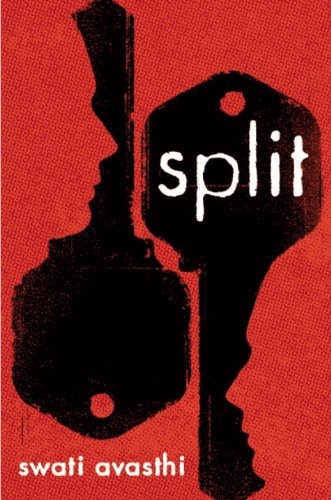
Split by Swati Avasthi


Sixteen-Year-Old Jace Witherspoon arrives at the doorstep of his estranged brother Christian with a re-landscaped face (courtesy of his father’s fist), $3.84, and a secret.

He tries to move on, going for new friends, a new school, and a new job, but all his changes can’t make him forget what he left behind—his mother, who is still trapped with his dad, and his ex-girlfriend, who is keeping his secret.

At least so far.

Worst of all, Jace realizes that if he really wants to move forward, he may first have to do what scares him most: He may have to go back.
-This cover is so cool. Look beyond the keys. Do you see the faces? Sounds like a riveting read.

That's it for us. Your go :)

Friday, October 15, 2010

Sammy and Juliana in Hollywood

Today marks the last day of Hispanic Heritage Month. So I figured I should post a review to kickstart HHM for the rest of the 335 days of the year (I think that math is right????) We have recommended this book before but now I detail why exactly you should read it.

Sammy and Juliana in Hollywood by Benjamin Alire Saenz 2004
HarperCollins

IQ "'Sometimes dreams come true, don't they Sammy?' [Elena]
I wanted to tell Elena that the bad ones. They're the ones that come true. [Sammy]
But I just said 'Yeah, sometimes dreams come true.'" pg. 213

Sammy Santos does not enjoy living in Hollywood in the 1970s. Hollywood, New Mexico, a small town where the majority of people who live there are Mexican or Mexican American and looked down upon. His mother died of cancer and he takes care of his younger sister (Elena), and at times, his father. Sammy dreams of going to college, so he works hard in school and takes on various jobs. The summer before his senior year, Sammy falls in love with gorgeous, vulnerable, aloof Juliana. But what would a love story be without some tragedy? Sammy introduces us to his family, Juliana, his friends and their stories of love and loss, suffering and triumph.

This was a re-read for me and I don't remember much about it. Which is mind-boggling because upon re-reading it, I absolutely LOVED it. I remember that I really liked it and I remember being relatively young when I read it. I bought it somewhere that was selling it for a bargain price ($4) when I was in 5th or 6th grade, and there are two things I vividly remember from the book. I remember that it was the first book I read that had so many Spanish words. I learned many curse and slang words and I'm oddly appreciative of that. I also recall it being one of the first books I ever read to candidly discuss homosexuality (I also learned about the awful slur "queer"). Upon re-reading this book I think both of those points are important. There is no glossary in this book, no italics to show that it is a Spanish word. The reader must figure that out from themselves and use the context in order to translate it. I encourage readers to not just skip over the Spanish words, but to learn them (especially if you are pretty good at Spanish, you need to know the slang too, not just the formal talk. My friends who speak Spanish laugh at Spanish students "proper" Spanish). As for the look at how gay people were treated, I don't think many current students know how bad homosexuals had it in the '60s and '70s, even though that was supposed to be a "liberating and accepting" time. Sammy says it best concerning what love is deemed acceptable "It's funny, everyone had always told us love was another word for belonging. No one, no one had ever told me that love was another name for exile." (pg. 212) I wish it was funny because it was untrue, but it's not funny, and it's true.

The nice thing about re-reading is you find new things to appreciate. I was enthralled by how Sammy described people. I wanted to meet him just to hear how he would describe me. When talking about Juliana he says, "Sometimes, she could look at you and you could see what she was trying to tell you don't screw with me because I've been through things, and you don't know a damn thing about what it's cost me to be here, right here, right here on this worthless piece of ground, so don't treat me like I'm some crack on a sidewalk because if you step on me, you'll never take another step without thinking of me. I swear to God you won't." (pg. 13) He's very observant and has a sort of "old soul". He's well liked, but quiet, not a big fan of parties. However he does attend some parties and he's not really socially awkward. It was nice to read a book about a guy who's not a nerd (I know that sounds mean, but do you get what I'm saying?). I also love Juliana for that above quote but she frustrated me a bit. The title is sort of misleading because Sammy & Juliana's relationship is not the main focus of the story. However it does serve as the backdrop to everything that Sammy does.


Sammy and Juliana In Hollywood is an aching story that is apologetically depressing. I didn't remember it being so maddeningly sad. I'll tell you right now, this book is really about the little things making people happy. It's about leaving home, moving on from everything and anything and appreciating those little joys that are few and far between. This novel covers so much both historically and personally. The Chicano movement is on the rise, people are protesting the Vietnam war, violence against homosexuals, racism against all Brown people, class issues, ageism, students not being free to speak their mind. It's a lot to handle but Sammy has a lot to handle in his own life and this book mirrors his internal turmoil as well as the external. Sammy grows in leaps and bounds and it's the very definition of a rewarding experience to read about. There is so much more I want to say about this novel, but this review is already pretty lengthy. Zetta says it far better than I ever could. All I have to say is READ THIS BOOK.

Disclosure: Con mi dinero

Wednesday, October 13, 2010

WWOC: Monica Brown

Full Name - Monica Brown
Date of Birth - 10/24/69
Location - Flagstaff Arizona
Website - MonicaBrown.net
Genre -Children's Literature

Writing Credits and Awards
I have received the Américas Award for children’s literature and my work has received starred reviews in Kirkus and School Library Journal. My books have also been selected for several best of lists and as Junior Library Guild Selections.
Most recently published work(s), Side by Side: The Story of Dolores Huerta and Cesar/Lado a Lado: La Historia de Dolores Huerta y Cesar Chavez and Chavela and the Magic Bubble

Can you tell us a little something about Side by Side/Lado a Lado?
It’s my pleasure to share the “story behind the story” of this book. Writing this book was inspiring and intimidating because both individuals are my personal heroes. Dolores Huerta and Cesar Chavez did what some of us only dream about doing. They worked to change the world and make it better. They were dedicated to advocacy and human rights for our nation’s farm workers and believed, as I write in my book, “that it was time for the workers to share in the harvest.”

Few people know the important role that Dolores Huerta played as co-founder of the UnitedFarm Workers movement. I wanted to tell her story, and I wanted my daughters to know thatwomen can be incredible leaders in the fight for change.

As I was writing the book, it was an honor to talk with Dolores Huerta and her daughter, Lori de Leon, and I was thrilled that Dolores agreed to share a quote after reading the manuscript which is included in the book. At age 80, Dolores Huerta is still fighting for justice through her foundation. She is an inspiration to all! You can find out more at www.doloreshuerta.org.

Chavela and The Magic Bubble is wonderfully imaginative and colorful. It's also your first non bilingual picture book. Do you plan to write anymore in the future? The majority of my children’s books are bilingual English/Spanish and I hope that is always the case. It is the publishers decision, but if I have a choice, I will always go with bilingual books.

My books have also been translated into Greek and Portuguese. I’m hoping that there will be a Spanish edition of Chavela and the Magic Bubble in the near future!

Side by Side/Lado a Lado is your fifth biography. While reading it I took great pleasure in knowing children would be introduced to Dolores Huerta, a woman who worked just as hard as Cesar Chavez for the rights of immigrant workers. Why do you think it took so long for Dolores Huerta's story to be told for children?

This question would be hard to answer in a paragraph! The important thing to note is that we are in a moment where new voices and stories are being told that represent a multiplicity of identities and the diverse and complicated history of the United States.

Are you working on anything now?
Yes! I’m working on two projects—one is a biography of Pablo Picasso for a Spanish publisherand the other is another fiction picture book, tentatively titled, Maya’s Blanket. I also superexcited about a book I just completed, which is called Marisol McDonald Doesn’t Match, whichwill be out from Children’s Book Press in 2011. Other forthcoming books include, Pablo NerudaThe Poet of the People (Henry Holt 2011) and Waiting for the Biblioburro (Tricycle 2011)

Tuesday, October 12, 2010

Island Beneath the Sea - Isabel Allende

Island Beneath the Sea by Isabel Allende
Allende's newest historical fiction novel about Haiti was released in April, just a few months after the devastating hurricane hit Haiti. At a time when more people where interested in learning about Haiti, here comes Island Beneath the Sea. Sometimes, I marvel at the ability of author's to write fiction current to today's events.

Island Beneath the Sea is broken into two parts. Part one is Saint -Domingue (1770-1793) Novel begins with Toulouse Valmorain, a young French man who must travel to Saint- Dominque to check up on his ill father. Before that Toulouse was living the good life in France. French families including the Valmorain's don't talk about slavery, what they owe their fortune to. When Toulouse's father dies he takes over the sugar plantation.

The novel starts getting really good when Zarite is introduced, essentially this is her story. When we first meet Zarite, she's a skinny little girl. Zarite is purchased and groomed to Eugenia, Toulouse's lady maid (or less fancy personal slave)

The prologue is the voice of Zarite, looking back on her life. Beginning in the year 1770 and ending in 1810. Allende covers much ground. One of the books strengths is the history of Saint - Dominque, and the struggle of African slaves against French enslavement. The story moves at a great pace, the author doesn't introduce too many characters. Which sometimes happens with historical novel this size (457pgs) Allende does a wonderful job developing her characters.

Island Beneath the Sea is very well written, I couldn't stop reading. Allende's language is beautiful. In later years during the uprising in Saint Doninque Zarite protected, the kids, Rosette, her child with Toulouse and Maurice, Tououse's son with his first wife. Zarite was forced to protect Toulouse as well though he was never grateful. There were a few times when Zarite reminded me of Lizzie from Wench. Both women refused to leave their children behind and hope that being good and waiting will get their masters to give them their freedom papers. I felt Allende used death as a way great rid of not so good characters or to end story lines. To be fair to the author, I only start noticing the small things when the big ones are done very well. Allende did what she set out to do, told a good story and educated people about Haiti's history along the way.

I really liked this one but didn't love it. Even though I had a few issues with Islande Beneath the Sea, I still believe it's a very worthwhile read. Since there's much to be considedered, it would make a great book club selection.

Monday, October 11, 2010

Survival and Hope after the Earthquake in Haiti

Eight Days: A Story of Haiti by Edwidge Danticat illus. by Alix Delinois

The first three words that come to my mind when I think of Eight Days are healing, survival and hope. I think its the perfect first picture book after the earthquake in Haiti that killed many and forced the Island to rebuild. Rather than focus on loss, Danticat writes about a boy who is saved thanks in part to his imagination.

The story begins with 7 yr old Junior being pulled from the rubble eight days after the earthquake. Though Junior's body was trapped his mind was free, and each day he did something new. Junior tells the people assembled at his rescue what he did on each day.

Junior is having fun most days with best friend Oscar or his sister Justine. Though on the 5th day Oscar went to sleep and never woke up. "That was the day I cried"

I was touched by that line. Its not often boys are seen crying in books. I think Eight Days is quietly beautiful. Its also gorgeous. Delinois illustrations are simply wonderful. The colors are Haiti.

The note from the author in the back, is a must read for adults.

The earthquake on January 12, 2010, dramatically change their lives. Many watched loved ones die. Others, like Junior, were stuck in the rubble of their homes and were rescued several days later. Yet in spite of everything, Haiti's children still dream. They laugh. They live. They love."

There's so much more, including the fact that nearly half of Haiti's population is under fifteen. Danticat wrote Eight Days for the children. Though adults will take something away from it as well. Eight Days will touch your heart.

Scholastic the publishers of Eight Days are donating $10,000 to the International Rescue Committe (IRC). Click on the link and check it out. You can also make a donation of your own. Or simply buy a copy of Eight Days.

An NPR interview with the author

Sunday, October 10, 2010

N.C.


New Crayons was created so that everyone can share what new multicultural books they got for the week. We love reading about what everyone else got for the week so please comment with a link to your own New Crayons post or simply list the titles you got in the comments :)


This week we got...


Tarie


The Namesake by Jhumpa Lahiri

THE NAMESAKE follows the Ganguli family through its journey from Calcutta to Cambridge to the Boston suburbs. Ashima and Ashoke Ganguli arrive in America at the end of the 1960s, shortly after their arranged marriage in Calcutta, in order for Ashoke to finish his engineering degree at MIT. Ashoke is forward-thinking, ready to enter into American culture if not fully at least with an open mind. His young bride is far less malleable. Isolated, desperately missing her large family back in India, she will never be at peace with this new world.

Soon after they arrive in Cambridge, their first child is born, a boy. According to Indian custom, the child will be given two names: an official name, to be bestowed by the great-grandmother, and a pet name to be used only by family. But the letter from India with the child's official name never arrives, and so the baby's parents decide on a pet name to use for the time being. Ashoke chooses a name that has particular significance for him: on a train trip back in India several years earlier, he had been reading a short story collection by one of his most beloved Russian writers, Nikolai Gogol, when the train derailed in the middle of the night, killing almost all the sleeping passengers onboard. Ashoke had stayed awake to read his Gogol, and he believes the book saved his life. His child will be known, then, as Gogol.


Unaccustomed Earth by Jhumpa Lahiri

These eight stories by beloved and bestselling author Jhumpa Lahiri take us from Cambridge and Seattle to India and Thailand, as they explore the secrets at the heart of family life. Here they enter the worlds of sisters and brothers, fathers and mothers, daughters and sons, friends and lovers. Rich with the signature gifts that have established Jhumpa Lahiri as one of our most essential writers, Unaccustomed Earth exquisitely renders the most intricate workings of the heart and mind.


Doret


The Forty Rules of Love: A Novel of Rumi by Elif Shafak

In this lyrical, exuberant follow-up to her 2007 novel, The Bastard of Istanbul, acclaimed Turkish author Elif Shafak unfolds two tantalizing parallel narratives- one contemporary and the other set in the thirteenth century, when Rumi encountered his spiritual mentor, the whirling dervish known as Shams of Tabriz-that together incarnate the poet's timeless message of love.

Ella Rubenstein is forty years old and unhappily married when she takes a job as a reader for a literary agent. Her first assignment is to read and report on Sweet Blasphemy, a novel written by a man named Aziz Zahara. Ella is mesmerized by his tale of Shams's search for Rumi and the dervish's role in transforming the successful but unhappy cleric into a committed mystic, passionate poet, and advocate of love. She is also taken with Shams's lessons, or rules, that offer insight into an ancient philosophy based on the unity of all people and religions, and the presence of love in each and every one of us. As she reads on, she realizes that Rumi's story mir­rors her own and that Zahara-like Shams-has come to set her free.


Rain Is Not My Indian Name by Cynthia Letich Smith

The next day was my fourteenth birthday, and I'd never kissed a boy -- domestic style or French. Right then, I decided to get myself a teen life.

Cassidy Rain Berghoff didn't know that the very night she decided to get a life would be the night that Galen would lose his.

It's been six months since her best friend died, and up until now Rain has succeeded in shutting herself off from the world. But when controversy arises around her aunt Georgia's Indian Camp in their mostly white midwestern community, Rain decides to face the outside world again -- at least through the lens of her canera.

Hired by her town newspaper to photograph the campers, Rain soon finds that she has to decide how involved She wants to become in Indian Camp. Does she want to keep a professional distance from the intertribal community she belongs to? And just how willing is she to connect with the campers after her great loss?

Have a fabulous week and happy reading!

Thursday, October 7, 2010

This Week's Colorful Links

Color Me Brown is a feature in which the staff at Color Online shares some of their favorite links from the week. It could be an interview, review, discussion post, etc. It usually has something to do with race or literature or both. Share your own CMB links in the comments!


28 Days Later has started! This is run by The Brown Bookshelf and nominations are from Sept. 30-Oct. 31. This is a great campaign. Each day features a fabulous interview plus an opportunity to win some books ;)


During the twenty-eight days of Black History Month, we’ll profile a different children’s or young adult author and children’s illustrator. On March 1st, we’ll announce the winner(s) of books donated by our featured authors.


We need your help. We’re looking for the best new and unnoticed works by African-American authors. From picture books to novels, books fresh off the presses to those that have lurked in the background unsung for months or years–whatever books you like, we want to know. We’re specifically looking for new books and books that have “flown under the radar,” that are children’s or Young Adult written by an African-American author published by a traditional publisher for the trade market.


Mitali Perkins recaps a panel on Selling Color in a White World


Next came Karen Lotz, President and Publisher of Candlewick. "We feel relatively free from the pressure of gatekeepers," she said. "We're a creatively-led house."

She shared a story about Kareen Abdul Jabbar, who asked to meet with her at a recent BEA. The legendary basketball player came with one request: please package books for and about black kids with the same bling as books for the mainstream. Candlewick makes it a point to comply.

Elizabeth raised the elephant-in-the-room question: do covers featuring people of color hinder sales in mostly-white communities?

When it comes to cover decisions, Candlewick goes through a collaborative cycle that provides input to designers who have read the book mindfully and thoroughly.


It's time for the Cybils! (Children and Young Adult Bloggers Literary Awards). Nominations are open till October 15th, let's try and get some color in all the categories! Nominate (read the rules first!)

Heather interviews Mitali Perkins about her latest YA novel, Bamboo People

HZ] Your world really came alive as your wrote it. Is there anything from Burma or Thailand you can share with us? Anything that can bring this wonderful world closer to our own door? :)

[Mitali] My good friend who has lived and worked with the Karenni shared a beautiful tradition with me. When a friend or family member is about to leave on a journey, the community gathers and blesses the person by tying white strings around his or her wrist. Maybe we should tie white strings around our wrists for a day in honor of these suffering people. What do you think?


And don't forget, October is LBT History Month! (Thank you Lee Wind for the reminder)

Wednesday, October 6, 2010

WWOC: Barbara Caridad Ferrer


Full name: Barbara Caridad Ferrer (Yes, the Caridad is really mine!)

Birth date: 8/25

Location: New York, NY


Genre: Contemporary/Multicultural Young Adult

WiP or most recently published work: When the Stars Go Blue (St. Martin's Griffin/November 2010)

Writing credits: Adiós to My Old Life (2006); It's Not About the Accent (2007)

How frequently do you update your site? I blog regularly and since the site is built on a blog platform, fairly frequently. It also contains my Twitter feed, so you could say that my site is constantly being updated.


Is your site designed for reader interaction? Definitely. Between email contact, my Twitter feed and the blog entries, I love hearing from and interacting with readers.

Post of note, something in particular you want readers to check out:


War of the Words


Top 5 reads you’re looking forward to reading in 2010?


The Girls from the Revolutionary Cantina- M. Padilla

Maybe This Time- Jennifer Crusie

The Babylonian Codex- C.S. Graham

Forget You- Jennifer Echols

The Sugar King of Havana- John Paul Rathbone


From your blog, I've noticed you are a big fan of the arts. What draws you to the world of music and dance? How does this influence your writing (if it has any influence at all)?

I've been both a reader/storyteller and a musician literally my entire life. I wouldn't begin to know how to exist without either. I've also dabbled in other arts, taking ballet as a child, being a competitive figure skater, and most recently, I've taken up photography to indulge my love of visual arts (I cannot draw to save my life- literally. I'm TERRIBLE.) I wish I could adequately describe the depth of emotion a beautiful piece of music or art or a dance performance can evoke in me. It's what I try to express within the written word and hopefully, if I've even come close, the reader will at least get a sense of the passion I have for the arts. It's so important, to me, to find the beauty in the world, especially as it grows increasingly dark around us. The arts are the purest expression of joy I can think of.


Please share what your newest release, When the Stars Go Blue, is about.


Basically, STARS is a modern retelling of the CARMEN story, first written as a short story by Prosper Mérimée, then adapted into the opera by George Bizet. (As well as a ballet, by Roland Petit.) The basic story is of the Gypsy, Carmen, who woos an inexperienced soldier, Don José, who basically renounces everything for her, then murders her when she rejects him for the bullfighter Escamillo. My version is a bit looser interpretation- my "Carmen" is Soledad Reyes, a driven dancer with dreams of becoming a professional, "Don José" is Jonathan Randall, an equally driven music prodigy who falls for Soledad, but whose has some longstanding personal demons to deal with, and finally, my "Escamillo" is Taz, a Spanish soccer player who's brash, cocky, and completely charming. My story plays out against the backdrop of competitive drum and bugle corps, of which Jonathan is a longtime member. He recruits Soledad to join the corps, because they're going to be performing Carmen and they need a dancer to portray the role of the gypsy-- Jonathan also has ulterior motives, because he's harbored a longtime crush on Soledad. The dual pull of the role of a lifetime, plus unrequited desire proves to be too tempting for Soledad to pass up, so she joins the corps and becomes involved with Jonathan. Of course, that's when Taz shows up, providing a distraction and making Soledad question everything she thinks she knows.

And in an eerie echo of the story they perform every night, tragedy strikes.


100 words or less how would you describe your work?

I have the hardest time describing my own work. Those who have read it use the words "lush" and "lyrical" and I have to say, I find that both humbling and incredibly flattering, since those are two things I really strive for in my writing. I want the reader to feel as completely immersed in the world I'm creating as I was when I was writing it.

100 words on less please share your thoughts on the writing life

The writing life is not one that's easy, but it's easily the most gratifying thing I've ever done. And it's really the perfect profession for me because it allows me to incorporate every passion and interest I have. It's sort of like acting, in that I get to be those people for as long as I'm writing the story. Writing is completely yours in a way that very few other professions can be.

I was fortunate to receive an ARC of When the Stars Go Blue and everyone is in for such a treat! The writing is lush and sublime ;) The romance is absolutely enthralling and the love triangle is actually realistic (i.e. there is no obvious choice of who Carmen should choose until the very end). As for the ending, possibly one of the most dramatic (in a good way) and tense endings I've read in a long time. Ms. Ferrer does indeed completely immerse you in the world of her characters, you care deeply for them and get a good idea of the environment they are living in. Utterly fabulous! I adored Adios to My Old Life and It's Not About the Accent was a very interesting read. I highly highly recommend all of Ms. Ferrer's books.

Tuesday, October 5, 2010

Interview with Jen Cullerton Johnson

Seeds of Change by Jen Cullerton Johnson is a wonderful picture book biography on Wangari Maathai. My review now enjoy the interview

Hi, Jen and welcome. Can you tell us a little about yourself?
I live and teach Spanish in Chicago. I just started a new teaching job at Simpson Academy for Young Women.

I also teach composition at St. Augustine College. When I am not teaching, I love to hang out
with my friends and family, especially my son Nico. We like to sail, ride our bikes,
and go to used books stores.

Who is Wangari Maathai?
Wangari Maathai is a woman, an African, a mother, a grandmother, a scientist, an environmentalist, a sister, a Kikuyu, a leader, a daughter, a Kenyan, a reader,
a writer, and most importantly a human being who knows we are all connected
no matter if we are plant, animal or human.

Wangari Maathai’s achievements have widened the road for women and Africans. Wangari’s life is an amazing life of “firsts”. She was the first East African woman ever to earn her PhD, an
advance degree in science. She was the first African woman ever to win the Nobel Prize. She was the first woman to organize young poor women to 30 millions plant trees in her home country of Kenya.

Have you ever planted a tree?
Yes! Yes! Yes! I love planting seeds and saplings. I hope all of your readers will plant a tree. There is a little trick to planting trees. When you buy a tree, there are always directions that come with how to plant the tree. I follow those directions. But I do two things differently.

First when you dig the whole, make sure it is wide enough and deep enough. I always try and put a little compost in the hole to give the tree some boost. Finally when the tree is planted and the dirt covers up the roots, I say a few words of thanks to the tree and to life for connecting me to the earth. I know it sounds sappy but I feel like the trees I have planted have heard me. All of them thrive! If you don’t believe try it yourself!

I've never planted a tree but I've said words of thanks to a few. So if that's sappy I am right there with you.

How many times have you read Dr. Maathai memoir, Unbowed?
I read Unbowed four times. The first two times I read her memoir for pleasure. I love Wangari’s cadence. She has such a graceful yet powerful way of stringing together words. I read the book two more times for research and once before I wrote the book and then afterwards to double-check my facts.

What amazes me is how Wangari spoke to many different kinds of people from poor women to presidents, school children to ambassadors. Her words inspired all around her to action. You can feel her persistence and commitment in her speeches. Her words moved me from a passive watcher to an active doer.

When she said Hajabee, Let’s work together, I understood it didn’t just mean turning off a light or recycling a water bottle but being aware of my actions and how my actions impact the world around me. I wanted readers to “hear Wangari”. I decided I would take every opportunity to use Wangari’s own words, so when the book is read, it feels as if Wangari Maathai is the room since the words belong to her.

I loved the direct quotes. The reader isn't just learning about Wangari Maathai they are hearing her as well.

With only 40 pages, you've managed to share many facts about Dr. Maathai

How did you decide what to keep and what to leave out?
Wangari Marathi’s life had many challenges. For example, she was thrown in jail for planting trees. My editor Jennifer Fox at Lee & Low never hesitated. She never doubted that telling the truth was important to telling Wangari’s story. There is a line in Seeds of Change that says,

“One day while she was out planting a tree, some wealthy businessmen paid corrupt police officers to arrest Wangari.”

This is a tricky line with big implications. But Lee & Low did not shy away from the truth, but like the life of Wangari Maathai, they stood firm.

I will always be grateful to them for their deep respect for story and truth telling.

Seeds of Change does its best to include the highlights of Wangari’s extra ordinary life. There are a few other great books written about Wangari that deal with only her involvement with the Green Belt Movement and planting trees.

I wanted readers to see a deeper side to Wangari—from when she was a girl wanting to go to school to when she stood to give her speech in Oslo.


All the things you just mentioned are the reasons why Seeds of Change stands out amongst the other children's biographies about Dr. Maathai.

A good picture book biography is all about balance between facts and readability. You've managed to get it just right.

What was your initial concern, facts or readability?
I don’t think I thought in those terms. What first drew me to writing about Wangari Maathai's life was not the fact that she planted 30 million trees in Kenya but her persistence to find solutions for difficult problems. How do you conquer poverty without destroying the land? How do you preserve the land without disempowering the poor?

Wangari took these two complicated issues, poverty and the environment, and found her own answer. Wangari taught poor women a very specific skill; how to plant a tree. By doing so the women planted trees all over Kenya, creating what looked like green belts across the land. The powerful image of green growing again in Kenya gave birth to the name Green Belt Movement.

A movement, that thrives today as an international organization for the environment and the rights of the disempowered. I wanted Seeds of Change to reflect that fusion on passion and practice.

Young people are smart. They understand how facts and storyline weave together. I was aiming for truth and with truth no matter how difficult or strange, comes beauty –or at least that’s what the Irish poet Yeats seems to think.


This is the first time I've ever had the urge to read Yeats.

Can teachers still get a free Skype Author talk or 1/2 off an school visit, if they purchase Seeds of Change?

You bet. I love to visit schools. I like to have the students write about nature and then together go out and plant a tree in solidarity of the Green Belt Movement. As an educator, I know budgets have been cut and funding is low. If teachers or students buy a copy of the book, I will give them half off a school visit.

But if you want to know a little secret, Skype visits are even better. All you need is an internet connection and a computer with a video on it. It's a low cost but high tech way to connect

I enjoy Skype visits and my author talks are free! If you want to try one, just go to my
website for more information.

I’d like to say thanks for this inteview. Doret’s passion for books and her desire to represent all readers-- no matter their race, creed, or gender—is like Wangari’s idea small as a seed that reaches the highest sky! 30 million planted trees. 30 million inspired readers!

30 million readers or 3. I may have inflated my visitor numbers a tad to get Jen to agree to do this interview. Though seriously I enjoyed Jen's answer as much as Seeds of Change. Her passion shines through. I love authors who are truly committed to telling stories they care deeply about.

Lee&Low the publishers of Seeds of Change are currently having a back to school sale All books are 21% off and free when you spend $20 or more

Originally posted at my personal blog. I checked Lee&Low is still having a sale.

Monday, October 4, 2010

Create Dangerously by Edwidge Danticat

Create Dangerously by Edwidge Danticat
"In this deeply personal book, the celebrated Haitian American writer Edwidge Danticat reflects on art and exile, examining what it means to be an immigrant artist from a country in crisis. Inspired by Albert Camus lecture Create Dangerously, and combining memoir and essay, Danticat tells the stories of artists, including herself who create despite or because of, the horrors that drove them from their homelands and that continue to haunt them."

The above is from the inside flap and truly captures what this book is about. Danticat opens with the 1964 public execution in Haiti, under dictator Francois "Papa Doc" Duvalier of two artist, Marcel Numa, Louis Drouin. The author quickly establishes that some artist risk their lives to create and speak in a hostile environment. This work addresses the role immigrant artist must play for their birth countries that suffer from censorship and unjust rule. We learn about many Haitian artist. Some who gave hope and inspiration, others who were exiled or murdered. Danticat tells us about Jean Dominque, a journalist who spent his life speaking out against the government and was assassinated. Sharing stories and memories, Danticat makes Dominque real.

"During the dictatorship in the early 1960's, a young Jean had created a cinema club, hosting weekly screenings at the Alliance Francaise in Port-au-Prince. There he showed films such as Federico Fellini's La Strada, which is, among other things, about a girl's near enslavement as a circus performer. "If you see a good film correctly" Jean said, "the grammar of that film is a political act. Everytime you see Fellini's La Strada, even if there is no question of fascism, of politcal persecution, you feel something against the black part of life." Another favorite of his was the Alian Resnais documentary Night and Fog, which describes the horrors of concentration camps. "To us, Auschwitz was Fort Dimanche," he said, referring to the Duvalier-era dungeonlike prison where thousands of Haitians were tortured and killed."

Danticat's writing is inviting, beautiful and honest. At times I felt the author shared more then she probably thought she would. Create Dangerously is a very powerful read. Read an excerpt

Sunday, October 3, 2010

New Crayons :)


New Crayons is a meme created by Color Online founder, susan. In this meme, anyone can participate, all you have to do is share what new multicultural books you got for the week. Leave a link to your New Crayons post in the comments.

And in case, you missed any posts last week from Color Online, here they are...

9/27 Monday-2010 YA/MG African American releases

9/28 Tuesday-A TED video of author Eli Shafak. It's a thought-provoking speech.

9/29 Wednesday-Women Writers of Color Interview with Renee Watson

9/30 Thursday-Color Me Brown links. There were lots of awesome posts this week!

10/1 Friday-Nada

10/2 Saturday-Review. Before You Suffocate Your Own Fool Self by Danielle Evans


This week Doret got

Island Beneath the Sea by Isabel Allende

Born a slave on the island of Saint-Domingue, ZaritÉ -- known as TÉtÉ -- is the daughter of an African mother she never knew and one of the white sailors who brought her into bondage. Though her childhood is one of brutality and fear, TÉtÉ finds solace in the traditional rhythms of African drums and in the voodoo loas she discovers through her fellow slaves.

When twenty-year-old Toulouse Valmorain arrives on the island in 1770, it’s with powdered wigs in his baggage and dreams of financial success in his mind. But running his father’s plantation, Saint Lazare, is neither glamorous nor easy. It will be eight years before he brings home a bride -- but marriage, too, proves more difficult than he imagined. And Valmorain remains dependent on the services of his teenaged slave.

Spanning four decades, Island Beneath the Sea is the moving story of the intertwined lives of TÉtÉ and Valmorain, and of one woman’s determination to find love amid loss, to offer humanity though her own has been battered, and to forge her own identity in the cruelest of circumstances.


This week Nathalie got...

One Million Men and Me by Kelly Starling Lyons

On October 16, 1995, Black men of all ages, religions and backgrounds gathered at the Lincoln Memorial in Washington, D.C. They were there on a mission - to mobilize and motivate, as part of what would become the largest event of its kind in U.S. history: the Million Man March. The Million Man March was a movement like no other. It brought together Black men who were committed to inspiring and empowering themselves and each other to make positive and lasting changes in their families and communities. The March was widely covered by news media across the country and the world. Now, this new picture book shares the story of the March in a new light: through the eyes of a little girl who was with her father the day Black men made history.


I Love My Hair! by Natasha Anastasia Tarpley, illustrated by E.B. Lewis
No matter how gently Mama pulls as she combs Keyana's hair, it still hurts. Keyana doesn't feel lucky to have such a head of hair, but Mama tells her she is because she can wear it any way she chooses.

This week Ari got...

Born Confused
by Tanuja Desai Hidier

Dimple Lala doesn't know what to think. Her parents are from India, and she's spent her whole life resisting their traditions. Then suddenly she gets to high school and everything Indian is trendy. To make matters worse, her parents arrange for her to meet a "suitable boy." Of course it doesn't go well -- until Dimple goes to a club and finds him spinning a magical web . Suddenly the suitable boy is suitable because of his sheer unsuitability. Complications ensue. This is a funny, thoughtful story about finding your heart, finding your culture, and finding your place in America.

Summaries from Amazon.com

So what new books did you get this week?